The Study Cake - AI Vocabulary Learning App & UI/UX Design

Easy as Cake: Turning the Words You Meet Into Words You Keep
1. The Word You Met This Morning Is Already Fading
In 1885, Hermann Ebbinghaus measured how fast we forget. When researchers replicated his experiment in 2015, they found the same curve: without review, most of what we learn is gone within a day.
Forgetting is not the whole story, though. Three other findings shaped this product:
Recalling beats rereading. In Roediger and Karpicke's study (2006), students who practised recalling a text remembered much more of it a week later than students who simply read it again.
Games help people learn. A meta-analysis of gamified learning by Sailer and Homner (2020) found a clear positive effect on what people actually learn (g = 0.49), stable even in the most rigorous studies.
Need makes words stick. The Involvement Load Hypothesis (Laufer and Hulstijn, 2001) says we remember a new word better when we genuinely need it.
Put together, the idea was simple. The best moment to learn a word is the moment you need it. The best way to keep it is to play with it, again and again. That idea became The Study Cake.
2. The Problem: Busy People Meet New Words Every Day, Then Lose Them
We built for university students and working professionals. Professionals run into new specialist terms all the time: in a contract, a client email, a technical document. They don't have time to sit down with word lists. So they look a word up, understand it for a second, and move on. A week later, it's gone.
What learners told us
We surveyed 30 Vietnamese learners and followed up with interviews. Three problems came up again and again:
"I never get to practise." Looking a word up once is not learning it.
"There's no path." Learners didn't know what to learn next.
"I don't know where to start." This was even harder with specialist vocabulary, which general courses rarely cover.
Most learning apps answer this with more setup: build a deck, pick a level, set a goal. For busy people, setup is exactly the step they skip.
3. My Role
I was Head of Product and Design. I led the product direction and owned the whole design process: research, user flows, wireframes, the design system, high-fidelity UI and user testing. I worked with our founder on the business model, with our engineering lead on what we could ship fast, and with two illustrators who created the Cake characters and brand, which I then turned into a working interface.
4. The Key Decision: Zero Setup
"Save" is the only thing the learner has to do
I set one rule for the product: the learner does one thing, and Cake Buddy does the rest. Cake Buddy is a chat-based AI tutor. You ask it about a word, it explains the meaning in context (in English and Vietnamese), and one tap saves it to your collection. From there, flashcards and mini games are generated automatically. No decks, no settings, no configuration.
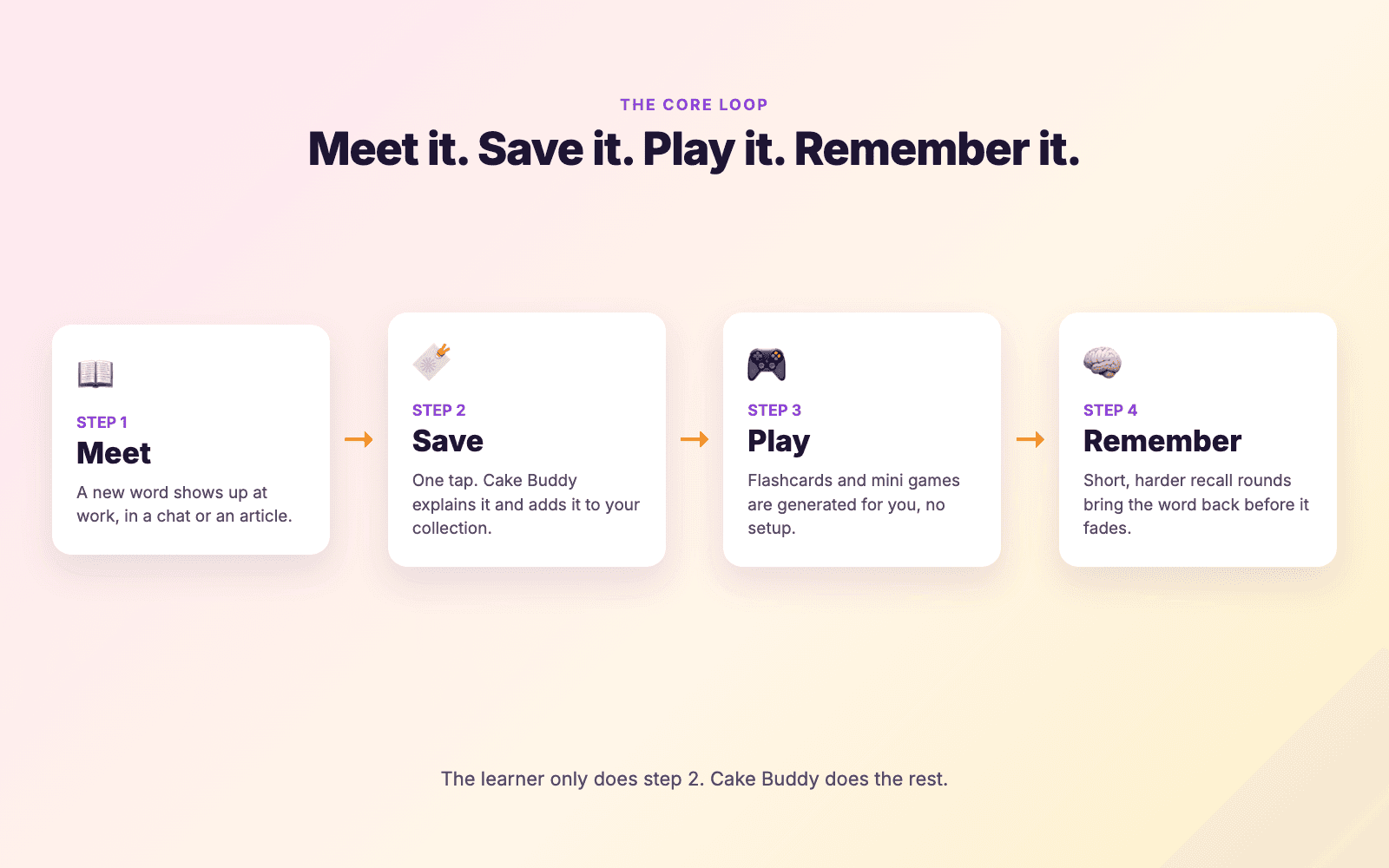
Why start from a chat, not a flashcard
People already ask "what does this word mean?" in a chat. Starting there meets learners where they already are, and turns a one-off lookup into the first step of learning. It also answers the "I don't know where to start" problem: you start with the word in front of you.
5. Practice That Gets Harder as You Get Better
Because recalling beats rereading, every game asks the learner to pull the word out of memory, not just look at it. The games climb a ladder, and each step asks a little more:
Hear and spell: recognise the word by sound.
Pick the meaning: recall what it means.
Build a sentence: use it in context.
Voice roleplay: say it out loud in a real conversation, like making weekend plans with a friend.

Rounds are short, with hearts, a timer and a clear finish line, so a session fits into a coffee break. Every finished lesson ends with a small celebration and EXP, a quick win that brings people back tomorrow. We also required a minimum number of saved words before a game unlocks, so every round feels worth playing.
6. Bright, Friendly and Mobile First
Bright on purpose. Most crypto and Web3 apps are dark and technical. We went the other way: warm pinks, oranges and playful cake characters, so learning feels light. The brand promise is in the name: easy as cake.
Mobile first. User testing showed that learners wanted the phone, not the desktop (more on that below). So I pushed the team to design for mobile first. It is where people meet new words, and it is where the hardest layout problems were.
Our own component kit. I designed the UI kit and every component from scratch, with no off-the-shelf UI library. That gave The Study Cake its own look, and gave designers and developers one shared set of components to build from.
Native apps, not just a website. I argued for shipping on the App Store and Google Play early. A real app in the stores made the product more credible to users and to investors.

7. One Learning Core, Two Business Models
The learning loop never changed. What changed was the reward layer on top of it, and I designed it that way on purpose.
Hackathon version (VoCake): built on the COTI blockchain. Learners connect a wallet, teachers publish vocabulary packs as NFTs, and learning earns tokens.
Vietnam version (The Study Cake): blockchain is still a barrier for most Vietnamese learners, so EXP became real rewards instead: vouchers from Tiki, Fahasa and Shopee, plus study abroad and learning opportunities.
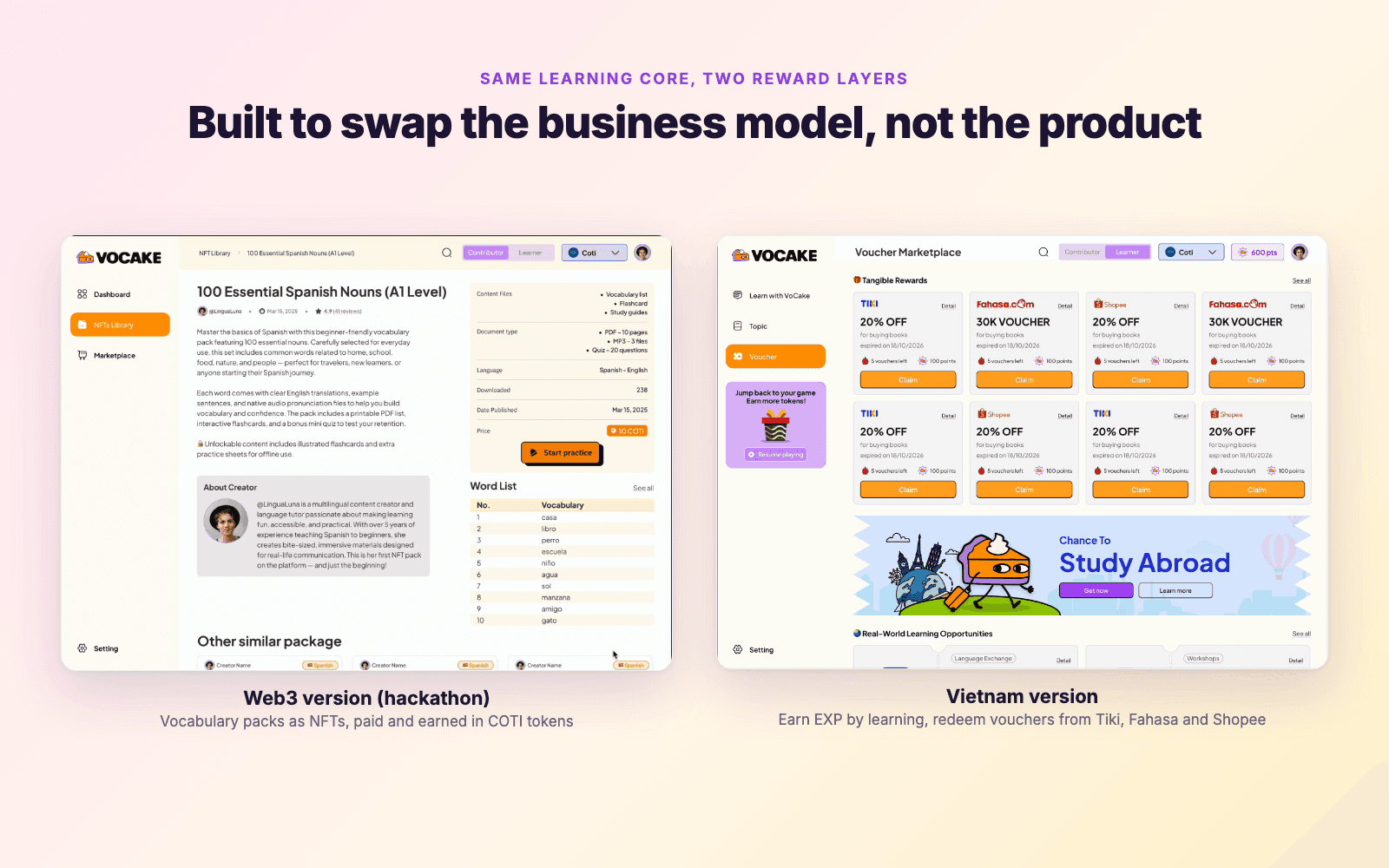
Keeping rewards as a separate layer meant we could follow the right market without redesigning how people learn.
8. Testing With Real Learners
Before any high-fidelity work, I turned the wireframes into a clickable prototype and tested it with friends who were learning English and with a group of 30 students.
The biggest finding: learners reach for their phone
We started with a desktop web app in mind. Testing changed that. Learners told us they wanted to use it on their phone, because that is where they can look a word up anytime, anywhere: on the bus, in a meeting, while reading on the go. A desktop tool would only catch the words they met while sitting at a computer.
That lined up with our whole idea of learning a word the moment you meet it, so we moved to mobile first. The wireframes were rebuilt around a phone screen before we went into the design system and final UI.
9. The Result
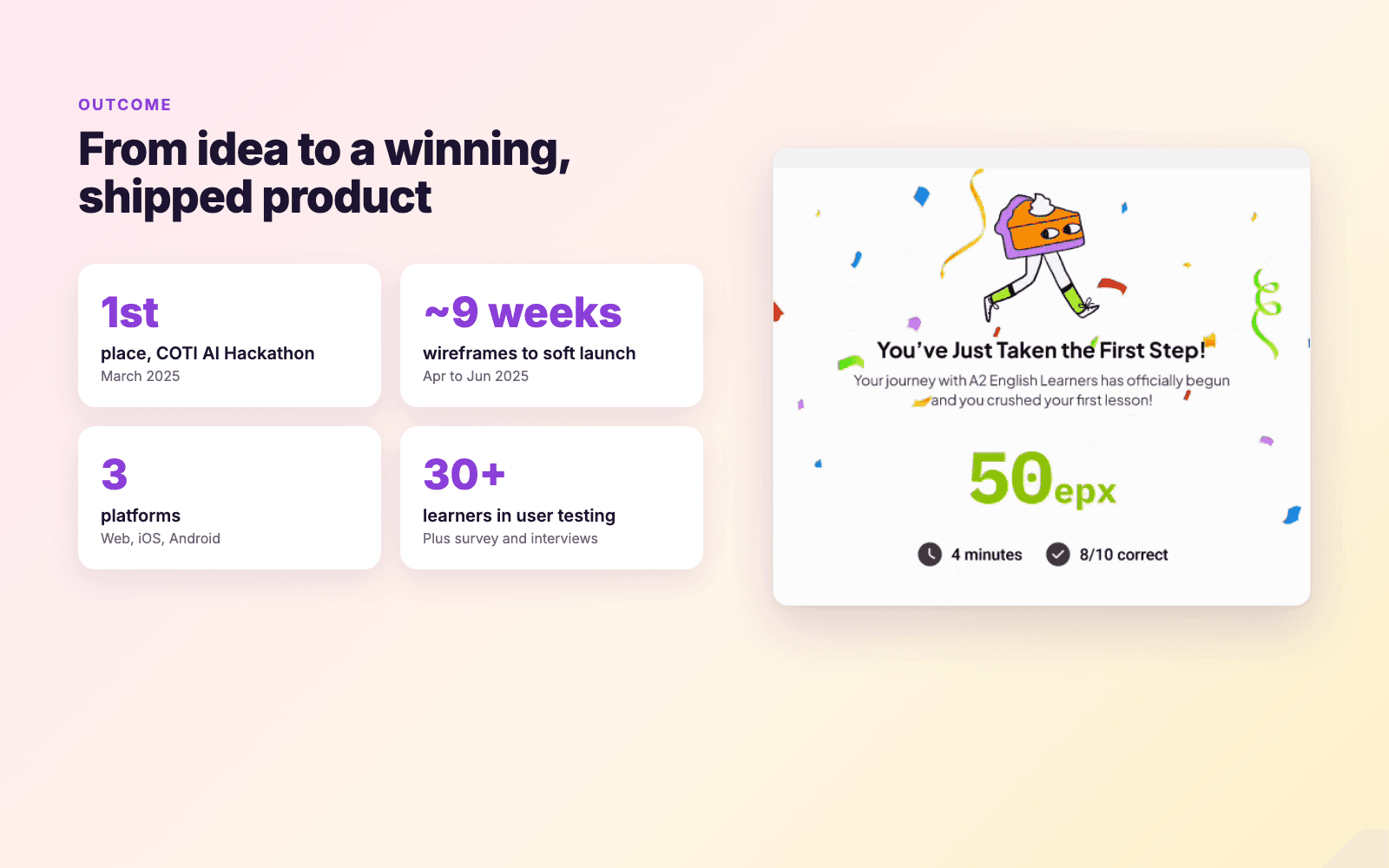
1st place at the COTI AI Hackathon in Bangkok (March 2025).
About 9 weeks from wireframes to soft launch (April to June 2025), on web, iOS and Android.
20 people joined the waitlist after the soft launch.
The company later changed its business direction, but the product did what we set out to prove: vocabulary learning can start from the word in front of you and need zero setup.
What I Learned
Remove setup, not features. The biggest UX win was taking work away from the learner, not adding options.
Let research lead. Learning science gave us the "why" behind every game, which made decisions faster and easier to defend.
Keep the core stable and the business layer flexible. It let a small team move between Web3 and a local market without starting over.